My first encounter with Peter Russell’s poetry dates back to 1993. I don’t remember exactly who gave me a poem by the great English poet, Theories and Other Lyrics, published in 1990. Accustomed as I was to reading authors, mostly Italian and, above all, representatives of that minimalism in which Italian poetry seemed to be mired at the time, poetry that, however, was still suffering from all the experimental experiences that had passed through it, leaving behind some signs of renewal, but also undoubted damage. (I would later read other poems by Peter Russell, such as Poems from the Valdarno, Albae Meditatio; The Dried-Up Spring, Sonnets and others.) Returning to the aforementioned text, it struck me because it went far beyond the limits of common observation and the asphyxiating and limited poetics characteristic of many. It disseminated the history of humanity and the planet across an unlimited sphere, recovering the pulse of distant galaxies, immemorial and remote times, magically connecting them to the contemporary world. Even as it wandered this boundless universe, it also turned its gaze to contemporary history, from the social to the political sphere: a breadth, in short, entirely unusual, to my knowledge, regarding contemporary poetry. And then, the stylistic and formal characteristics, from the epic to the lyrical, from the moderate to the scathing ironic: hallmarks that I would variously encounter in subsequent works.
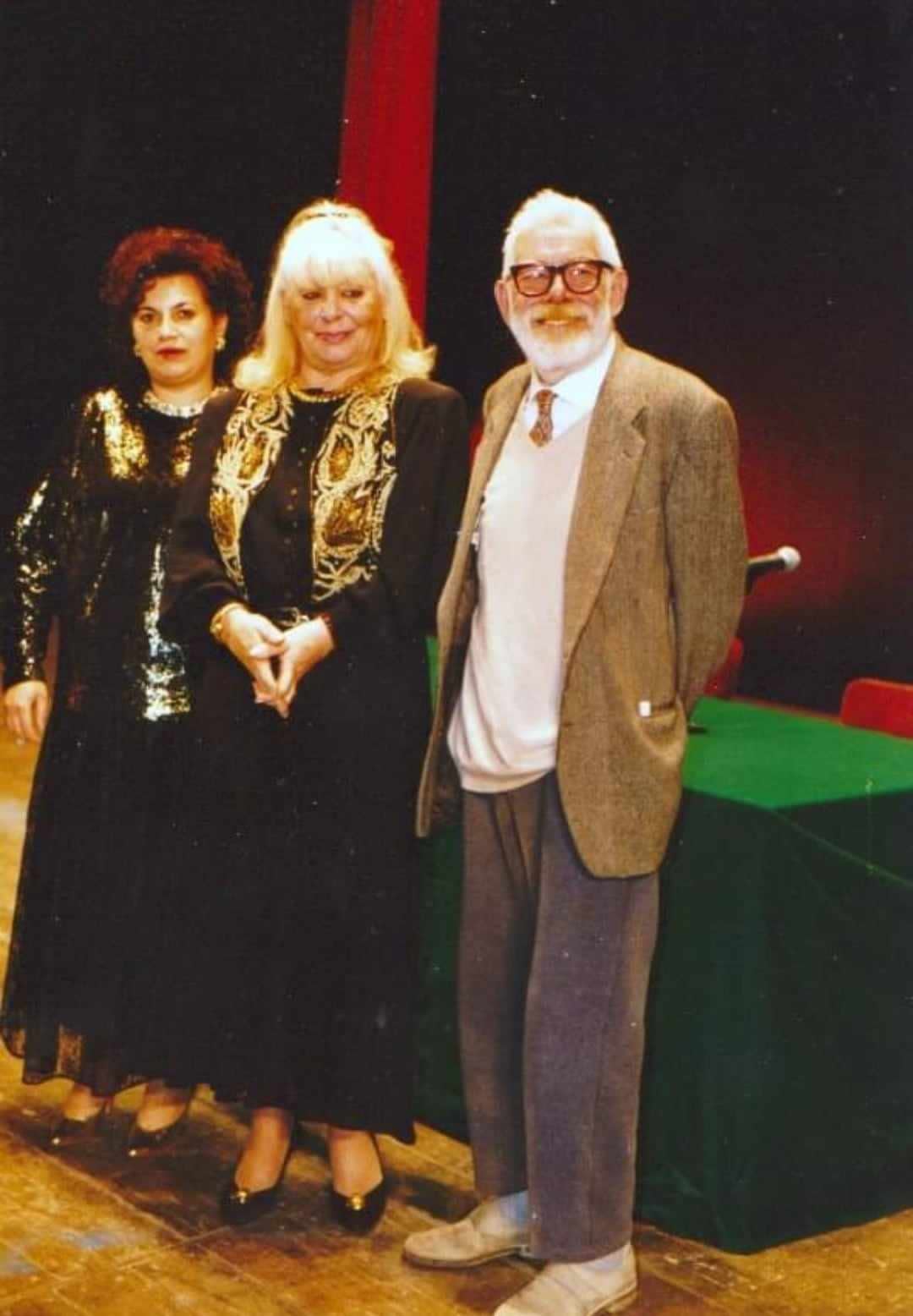
My task, on this occasion, is not to engage in critical analysis or commentary on his poetic work, but to sketch a human profile and physical description of Russell, albeit in brief and based on the impression that this figure of the poet and the man has given me, both in relation to our mutual correspondence, rich in his observations on poetry and art in general, and in relation to the fact that I knew him personally and had him as my guest for a few days. In early 1995, having learned that the poet lived in Pian Di Sco, in the province of Arezzo, I sent him a collection of poems, requesting his kind commentary. He evidently enjoyed the collection (Apeiron, which I would publish later), so much so that he expressed his willingness to present it, should I deem it appropriate. I accepted, obviously with enthusiasm, the great poet’s offer and, at the same time, sent him another unpublished collection, Humanity, for his preface. Apeiron was presented to the city of Reggio Calabria in November 1995, at the Francesco Cilea Municipal Theatre. Thanks in part to the presence of the poet (whom I had hosted at my home and would remain there for a few more days after the book launch), it had a significant impact, drawing a large audience, and garnering positive critical acclaim. It goes without saying that, regardless of the value of the work presented, Russell’s presence prevailed throughout the evening, with all its evocative power, thanks to his natural expressiveness and the clarity and simplicity of his language that make profound concepts with hidden meanings accessible to the most diverse audience. Indeed, he presented the work, approaching it from diverse perspectives, revealing its philosophical implications, its stylistic characteristics, and clearly demonstrating the diverse meanings of its poetics, with such exemplary clarity that no one in attendance missed the work’s significance. Here, that illuminating simplicity was a dominant feature of his way of speaking and writing: everything in his expression rejected complication, intellectualized frenzy, certain subtleties, which at times seem to credit the speaker or writer with acuity and conceptual depth but which, in reality, are nothing more than quibbles that mask the modesty of thought.
During my stay, I noted in this singular figure—a man, a poet, and an intellectual—the exemplary modesty, the humility that is characteristic of great minds, his incisiveness in arguments, both about humanity in general and the contemporary world, history, literature, and poetry in particular. As he spoke, I observed him attentively, contemplating his truly singular figure. He was tall and slender, almost gaunt, sporting thick, wavy, unruly hair, completely white, which intertwined with a flowing beard. He dressed modestly, wearing trousers that were short, relative to his build, and above his ankles. The expression in his eyes was distinctive, flashing with a vivid light or darkening with a chromatic hue, but always lively, perfectly conveying the dynamics of his thought. His language was extremely accurate, refined, and detailed, unlike even those who express themselves in their own native language. I learned various details of his life: his studies, his encounter with poetry, his stay in the United States and his wanderings around the world, his participation in the Second World War, his arrival in Italy, his move to Pian di Sco, which he chose as his permanent residence, as well as his permanent residence in Italy, which he chose as his second home. He also revealed to me his relationship with Ezra Pound, his commitment to having him released from the nursing home where the great American poet had been confined, and the deeply painful event of the fire in his (Russell’s) library in 1990, which resulted in the loss of his own writings and precious documents, as well as very rare books. He also mentioned some of his Nobel Prize nominations, which perhaps (in my opinion) he would have deserved. We spoke about the difficulties, natural for those who are far from their homeland, difficulties often of an economic nature (only a few months before his death, he was informed of the right to benefit from the Bacchelli Law, which he was unable to enjoy, having died on January 22, 2003 in the retirement home, in Castel Franco Sopra – Arezzo); but also regarding the affirmation of his poetic work, especially in a poet who made a convinced, almost religious profession of the conservation and exaltation of the absolute values of humanity and art. As already mentioned (and as I remember, he reiterated to me) he believed that beyond the dynamics and the becoming of art and poetry, these could not be reduced to formal expressions, to an often bizarre and imaginative search for new languages, but that style should always and in any case be accompanied by solid concepts representative of the fundamental and universal needs of man: he does not, therefore, abjure absolute values, with an awareness, obviously, of the crisis of man and of relativistic variants, but, in any case, he believes in the importance of the universality of the human being. and always, a tension toward the centrality of man, who is the creator and creator of poetry and art (without being reduced to a mere instrument): a poetry, in short, according to Russell, which without giving in to facile sentimentality, must be informed by sentiment, reflecting not only the physical needs but also the spirituality of man; it must also reach the highest peaks of thought and encompass the world in its entirety: in it, history and tradition, myth and contemporaneity must be contained in a single sphere. I had previously mentioned the modesty and simplicity of the great poet: both when he spoke and when he wrote, he did so with extreme calm, even if at times with vivacity and a slightly polemical verve, but to reaffirm respect for fundamental principles. Absent, however, were malice, contempt, refusal of comparison, intolerance: he simply believed, as his life and his work had demonstrated, that art, like life, should exalt great principles, great values (and he had also expressed this in the preface to my work, Humanity) and those absolutes, which so much philosophy, so much literature, so much poetry had too hastily and superficially relegated to oblivion, perhaps for a more obvious or easier pursuit. Maria Teresa Liuzzo.
© 2026, DetectivPress. Toate drepturile rezervate.