In the closing centuries of the Middle Ages, Northern Europe was dominated by an extraordinary political structure that united much of Scandinavia under a single ruler. At the heart of this vast realm stood Denmark, whose kings and queens transformed the kingdom from a regional power into the leading force of the North. Through political alliances, dynastic marriages, military influence, and strategic diplomacy, Denmark succeeded in bringing Norway and Sweden under the same crown, creating what became the largest political union in medieval Scandinavian history.
The roots of Danish power can be traced back to the centuries following the Viking Age. By the twelfth and thirteenth centuries, Denmark had emerged as the strongest kingdom in the Baltic region. Danish rulers expanded their influence across important coastal territories and islands, controlling strategic trade routes and maritime connections. During the reign of King Valdemar II in the early thirteenth century, Danish authority stretched across large portions of the southern Baltic coast and even reached Estonia, making the Baltic Sea effectively a sphere of Danish influence.
This expansion laid the foundations for Denmark’s future leadership in Scandinavia. While Sweden possessed vast natural resources and Norway controlled important North Atlantic territories, Denmark occupied the most advantageous geographical position. Situated between the North Sea and the Baltic Sea, it controlled vital maritime passages that connected Northern Europe with the rest of the continent. This strategic location enabled Danish monarchs to exert considerable political and economic influence throughout the region.
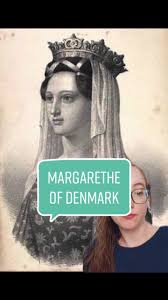
The decisive moment came in the late fourteenth century under the leadership of Queen Margaret I, one of the most remarkable rulers in Scandinavian history. Through inheritance rights and political negotiations, she secured authority over Denmark and Norway before extending her influence into Sweden. Her vision was to unite the Nordic kingdoms in order to strengthen their position against external threats and internal instability. At a time when the Hanseatic League dominated much of Baltic commerce and regional rivalries threatened Scandinavian security, a unified northern kingdom appeared both practical and necessary.
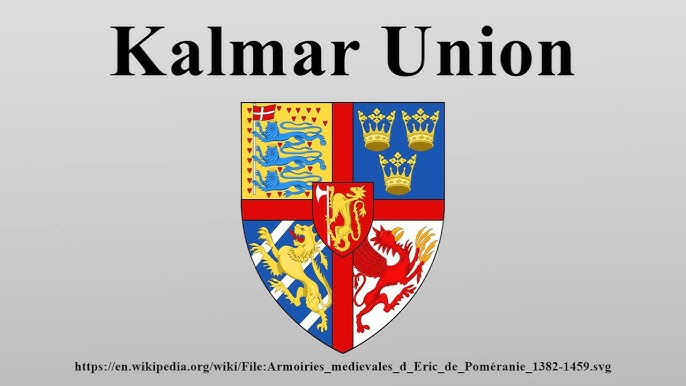
In 1397, representatives of the three kingdoms gathered in the Swedish city of Kalmar. There, a formal agreement established a union that brought Denmark, Norway, and Sweden under a common monarch. Although each kingdom retained its own laws, institutions, and aristocracy, foreign policy and dynastic authority were largely coordinated through the shared crown. The arrangement became known as the Kalmar Union and marked the beginning of a new era in Scandinavian history.
The union was far more extensive than modern maps of Scandinavia might suggest. Through Norway, the crown exercised authority over Iceland, the Faroe Islands, Greenland, and several North Atlantic possessions. Sweden contributed the vast eastern territories that included present-day Finland, while Denmark provided the political center and administrative leadership. Together, these lands created a realm that stretched from the Arctic regions and the North Atlantic to the Baltic coastlands, making it one of the largest political entities in Europe at the time.
The creation of a united Scandinavian realm was not the result of a single event but the achievement of several remarkable rulers whose political vision reshaped Northern Europe.
Among them, no figure stands taller than Queen Margaret I (1353–1412). Often described as one of the most capable stateswomen of the Middle Ages, Margaret inherited and consolidated power in Denmark and Norway before extending her influence into Sweden. Through diplomatic skill, strategic alliances, and careful negotiation with the Scandinavian nobility, she succeeded in bringing the three kingdoms under a common crown. Although her grandnephew Eric of Pomerania was formally crowned king of the union at Kalmar in 1397, Margaret remained the true architect and guiding force behind the political project. Her leadership laid the foundations for more than a century of Scandinavian unity.
Another important figure was Eric of Pomerania, the first monarch to rule the three kingdoms under the Kalmar Union. During his reign, efforts were made to strengthen central authority and reinforce the union’s international position. Although his policies eventually generated opposition, his rule represented the first practical attempt to govern the Scandinavian kingdoms as a single political entity.
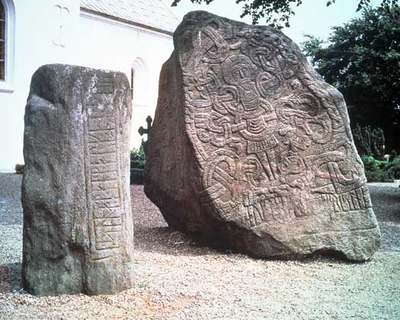
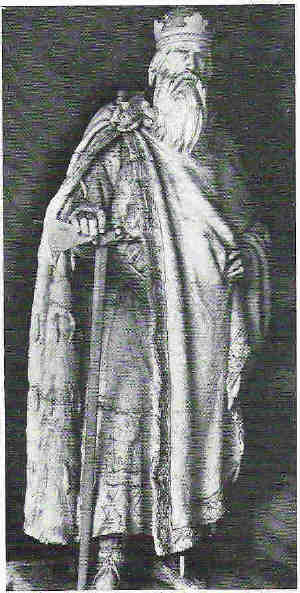
The emergence of Denmark as the dominant Nordic power had begun long before Margaret’s reign. Kings such as Valdemar I (1131–1182) and Valdemar II (1170–1241) expanded Danish influence throughout the Baltic region. Under their leadership, Denmark became one of the strongest kingdoms in Northern Europe, controlling important trade routes and territories along the southern Baltic coast. Their achievements provided the economic and political foundations upon which later generations would build the Scandinavian union.
lthough officially conceived as a partnership among equal kingdoms, Denmark occupied the dominant position within the union. Danish monarchs generally directed policy, and Copenhagen gradually evolved into the principal political center of the Scandinavian world. The Danish court became the focal point of diplomacy, trade, and governance, reflecting Denmark’s superior economic and strategic position.
For more than a century, the union provided Scandinavia with a level of collective strength that no individual kingdom could have achieved alone. It enhanced regional security, facilitated political cooperation, and increased the influence of the Nordic kingdoms in European affairs. Merchants, nobles, and church leaders benefited from stronger connections across the North, while the shared monarchy offered a degree of stability in a period frequently marked by dynastic conflicts elsewhere in Europe.
Yet the very size of the union also created difficulties. Swedish nobles increasingly objected to what they viewed as excessive Danish control. Differences in economic interests, political traditions, and regional priorities generated tensions that repeatedly challenged the unity of the three kingdoms. During the fifteenth century, several rebellions and political crises weakened the union, revealing the challenges of governing such a diverse and geographically dispersed realm.
The situation deteriorated further in the early sixteenth century. Conflicts between the Danish monarchy and Swedish political leaders intensified, culminating in a series of dramatic events that ultimately shattered the union. Following a period of unrest and resistance, the Swedish nobleman Gustav Vasa emerged as the leader of a successful independence movement. In 1523, Sweden formally withdrew from the union and established an independent monarchy, bringing an end to more than 125 years of Scandinavian political unity.
The collapse of the Kalmar Union marked the beginning of a prolonged struggle between Denmark and Sweden for supremacy in Northern Europe. Over the following centuries, the two kingdoms would compete repeatedly for territory, trade, and influence. Nevertheless, the memory of the union endured as the most ambitious attempt to create a unified Scandinavian state.
From a broader historical perspective, the Kalmar Union represented the peak of medieval Danish influence. Combined with the wider Danish-Norwegian realm that extended across the North Atlantic, it formed a political structure whose reach stretched far beyond the borders of present-day Denmark. Historians often regard this period as the height of Danish power, when Copenhagen stood at the center of a kingdom that linked the Baltic Sea, the North Sea, the Arctic territories, and the Atlantic world. The union demonstrated Denmark’s ability to shape the political destiny of Northern Europe and left a lasting legacy that continues to influence Scandinavian identity and cooperation today.
Main Sources Consulted
- Thorkild Kjærgaard – Danish Empire
- Denmark.dk – History of Denmark
- Team Queens – Scandinavia: Denmark, Norway and Sweden
© 2026, DetectivPress. Toate drepturile rezervate.