I would also like to thank Health & Wellbeing Magazine for the opportunity to share this work and for providing a platform where conversations about wellbeing, innovation, and new approaches to supporting people can reach a wider audience.
There is something particularly rewarding about seeing a project move from an idea, through many hours of work, learning and collaboration, to finally being able to share what we discovered with a wider audience.
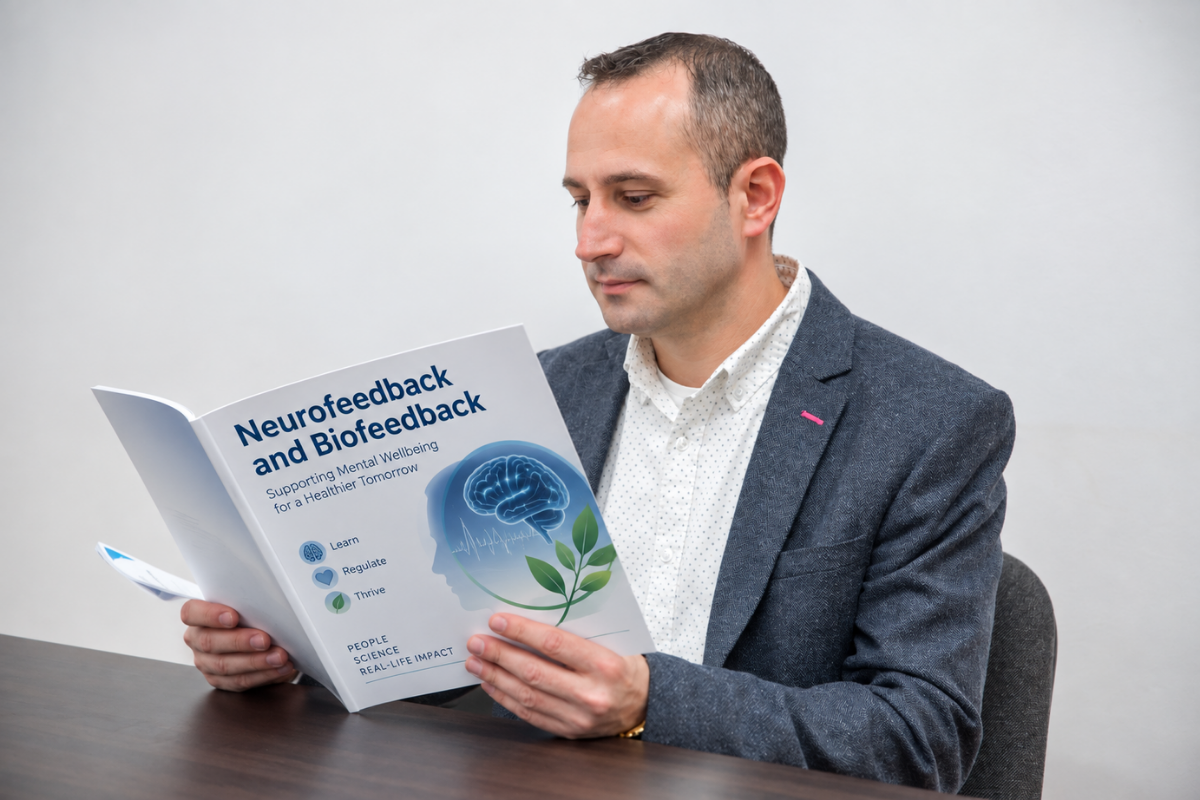
The article, “Can Neurofeedback & Biofeedback Help Us Switch Off?”, shares the story and learning from our Welsh occupational wellbeing pilot, exploring the use of Infra-Low Frequency (ILF) Neurofeedback alongside biofeedback with people working in emotionally demanding roles.
At the heart of this project was a simple but important question:
What happens to people who spend their working lives supporting others when their workday ends, but their nervous system doesn’t necessarily switch off?
People working in domestic abuse, safeguarding, crisis services and other emotionally demanding professions can spend much of their day listening to distress, managing risk, making difficult decisions and supporting people through some of the most challenging moments of their lives. We wanted to explore whether neurofeedback and biofeedback could offer a practical and acceptable way to create space for recovery, physiological awareness, and, perhaps most importantly, an opportunity to switch off.
I am particularly happy to see the results of a project that involved so much commitment from a wonderful team and from everyone who generously gave their time to participate.
What interested us was not simply whether people enjoyed the sessions, but what we could genuinely learn from their experiences.
Relaxation and being able to “switch off” became prominent themes. Participants generally found the approach acceptable and worthwhile, with some describing greater calm, mental space and an opportunity to temporarily disengage from work-related demands.
But perhaps one of the most valuable lessons was something much more human than technological:
Wellbeing has to fit into real life. 
Even when people valued the sessions, repeated weekend appointments had to compete with work, family responsibilities, travel, social commitments and the very recovery time the programme was intended to support. That taught us an important lesson about the difference between an intervention being acceptable and the way we deliver that intervention being sustainable.
For me, this is what responsible innovation in psychology and wellbeing should be about: remaining curious about new approaches while also being careful, transparent and willing to learn from the evidence, including the things that do not work quite as we expected.
This was a small feasibility and service evaluation, not a clinical effectiveness trial, and much more research is needed. We should therefore be careful not to make claims beyond what this project can tell us. But every meaningful research journey has to begin somewhere, and a good feasibility study helps us understand what questions we need to ask next.
I am proud that this work in Wales is contributing to a wider conversation about stress, recovery, physiological self-awareness and how we can better support the people whose professional lives are dedicated to supporting others.
None of this happens through the work of one person.
A very special thank you to Daniela Nedelcu and Sabina Serban, whose commitment, professionalism, enthusiasm and belief in this project have been such an important part of bringing it to life.
My sincere thanks also go to Thrive Domestic Abuse Services for their collaboration, openness and support, and for helping us explore how this work might translate into a real-world setting with people working in emotionally demanding roles.
I am also very grateful to BEE Medic for providing the ILF Neurofeedback protocol, equipment and practitioner training that supported the project.
And, most importantly, thank you to every participant who trusted us, gave up their time and shared their experiences so openly and honestly. 
Without them, there would be no project, no results and, most importantly, no learning to take forward.
I am genuinely proud of what we have achieved together.
This is not the end of the journey. It is a small but important first step, and I look forward to using everything we have learned to shape the next stage of our work.
Because ultimately, innovation in wellbeing is not simply about introducing new technology.
It is about understanding people better, listening to their experiences, learning from the evidence and continuing to ask how we can do better for those who spend so much of their lives caring for others. 
Dr Nistor Becia MBE
Chartered Clinical Psychologist
© 2026, DetectivPress. Toate drepturile rezervate.