Long before Disneyland became a symbol of modern entertainment, and centuries before the expression “theme park” entered everyday language, Denmark had already developed places where ordinary people could escape daily life through games, performances, food, music and spectacular attractions.
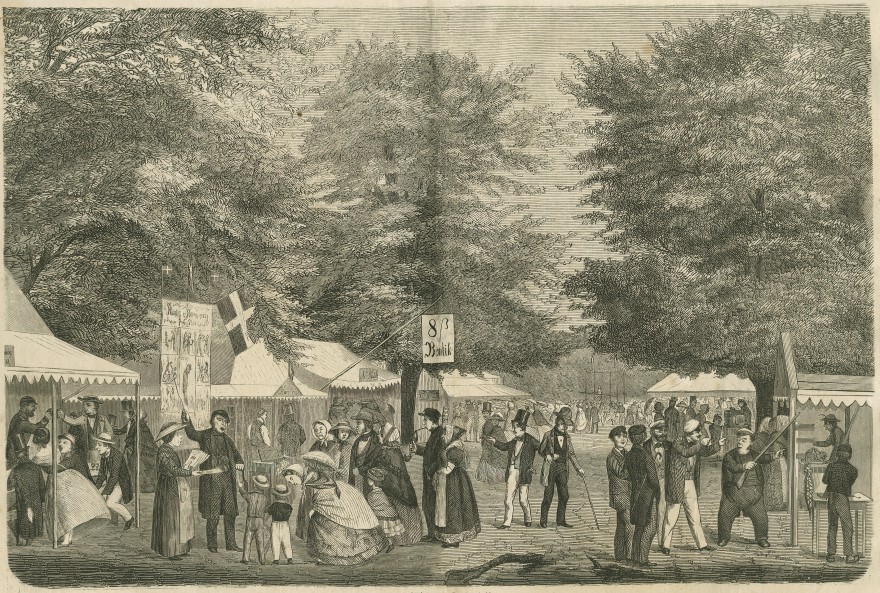
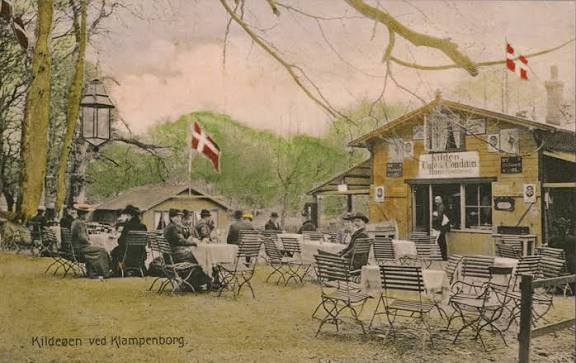
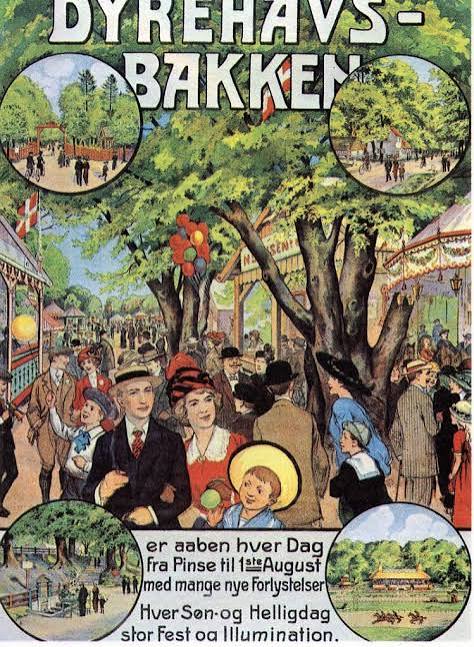
Two Danish institutions occupy an exceptional position in this history: Dyrehavsbakken, commonly known simply as Bakken, whose origins date to 1583, and Tivoli Gardens, which opened in central Copenhagen in 1843. Bakken is recognized as the world’s oldest operating amusement park, while Tivoli became one of the most influential amusement gardens of the nineteenth and twentieth centuries.
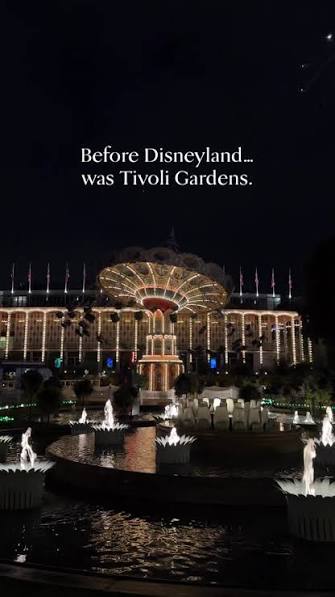
Their importance extends far beyond Denmark. Tivoli in particular became part of the international history of themed entertainment through its connection with Walt Disney, who visited the Copenhagen gardens while developing ideas for the park that would eventually become Disneyland.
The story of Bakken, Tivoli and Disneyland therefore reveals something remarkable: many of the principles that define the modern amusement park — escape from everyday life, carefully designed environments, entertainment for different generations, food, performances, rides and a distinctive atmosphere — had deep roots in Denmark long before Disneyland opened its gates in California in 1955.
Dyrehavsbakken: The World’s Oldest Operating Amusement Park
The history begins not with a roller coaster, carousel or mechanical ride, but with water.
In 1583, according to Danish tradition, a young woman named Kirsten Piil discovered a natural spring in the woodland north of Copenhagen, in the area today known as Jægersborg Dyrehave.
At a time when access to clean drinking water was far from guaranteed, the spring became famous. People came from Copenhagen and the surrounding region to drink its water, which many believed possessed healing qualities. The crowds were especially associated with the midsummer period around Sankt Hans.
Where crowds gather, commerce and entertainment usually follow.
Merchants began selling goods and refreshments. Performers, entertainers and showmen arrived to amuse the visitors. Temporary stalls and performances gradually transformed the area around the spring into a popular gathering place.
From this spontaneous mixture of nature, commerce and popular entertainment, Dyrehavsbakken was born.
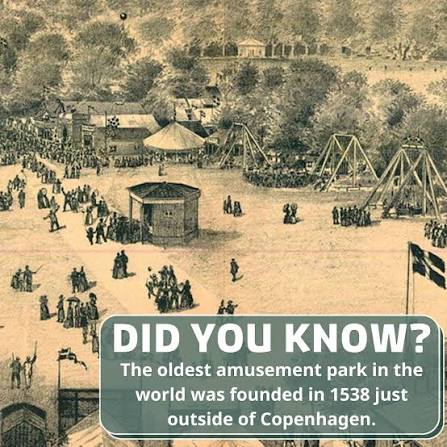
The official Bakken website dates its foundation to 1583 and describes it as the oldest amusement park in the world. More than four centuries later, it remains in operation in the woodland of Dyrehaven near Klampenborg, north of Copenhagen.
This extraordinary continuity makes Bakken historically unique.
Modern theme parks are normally designed before they are constructed. Bakken represents almost the opposite process.
There was no single architect who sat down in 1583 and designed an amusement park. There was no corporation, master plan or carefully orchestrated opening ceremony.
Instead, the park evolved gradually from a popular meeting place.
The natural spring attracted visitors; the visitors attracted merchants; the merchants and crowds attracted entertainers; and generation after generation continued the tradition.
This organic development helps explain Bakken’s unusual character even today.
Unlike many contemporary amusement parks, Bakken is situated within the natural landscape of Dyrehaven. Its official website emphasizes the combination of its historic atmosphere, woodland location, modern rides, restaurants, games and entertainment. Admission to the park itself remains free, while visitors pay for rides and other activities.
The park also preserves traditions that predate modern amusement rides. One of its most famous characters is the white-faced clown Pjerrot, who has entertained generations of children at Bakken for more than two centuries.
At the same time, Bakken gradually incorporated the technologies of modern amusement parks. Its famous wooden roller coaster dates from 1932, illustrating how an entertainment tradition originating in the sixteenth century successfully adapted to the mechanical amusement age of the twentieth century.
Bakken therefore represents something extremely rare: a direct historical bridge between the popular fairs and pleasure grounds of early modern Europe and the amusement parks of the present day.
More than two and a half centuries after Bakken’s beginnings, Denmark produced another landmark in amusement history.
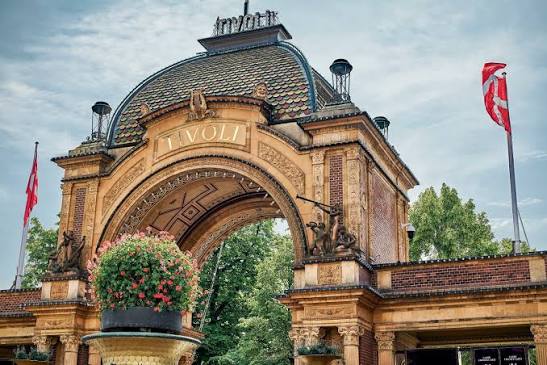
On 15 August 1843, Tivoli Gardens opened in Copenhagen.
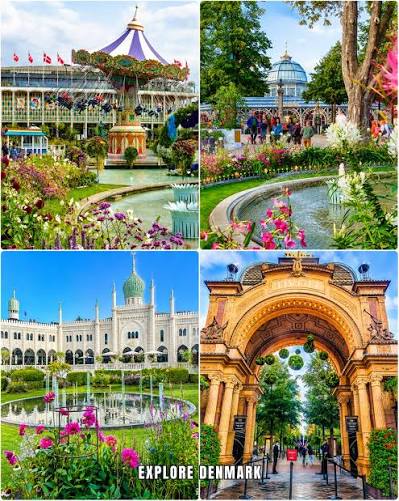
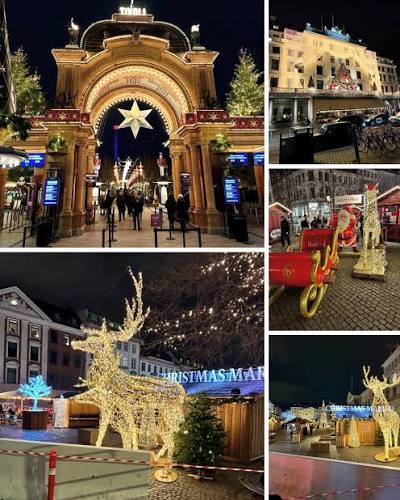
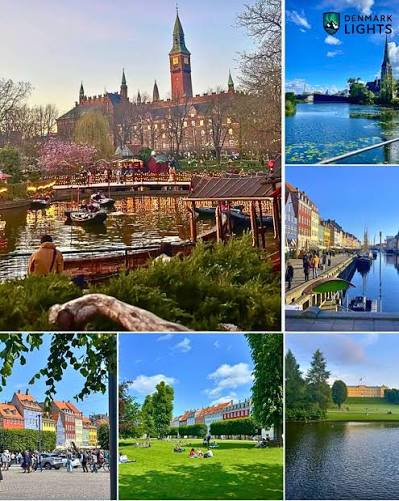
Its founder, Georg Carstensen, had received royal permission to establish the gardens. According to Tivoli’s official history, Carstensen had been inspired by amusement parks he had encountered abroad and created an environment that immediately fascinated visitors with its elegant and exotic appearance.
Tivoli represented a more deliberately designed form of entertainment than the organically evolved Bakken.
It was not merely a collection of rides.
From its earliest years, Tivoli combined gardens, architecture, restaurants, cafés, music, theatrical performances, illumination and amusements. Visitors entered an environment deliberately separated from the ordinary rhythm of the surrounding city.
That distinction would become enormously important to the later development of amusement and theme parks.
Tivoli and Danish Cultural Identity
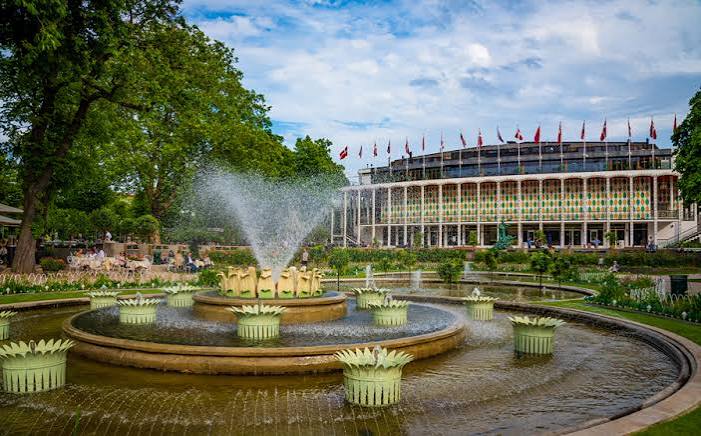
Tivoli occupies a particularly unusual location for a major amusement park: it stands in the heart of Copenhagen.
Instead of being isolated from urban life, it became integrated into the Danish capital and ultimately into Denmark’s cultural identity.
The Danish Architecture Center describes Tivoli as part of the country’s national identity, reflecting the extent to which the gardens became more than a commercial entertainment enterprise.
Over generations, Tivoli developed into a meeting place where entertainment and culture overlapped.
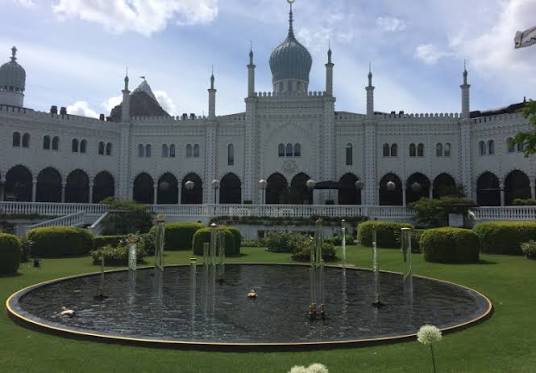
Concerts, theatre, ballet, restaurants, architecture, gardens and amusement rides existed side by side. This mixture gave Tivoli a character different from an ordinary fairground.
The gardens could entertain children while simultaneously appealing to adults. Visitors could ride an attraction, attend a performance, eat in a restaurant, listen to music or simply walk through illuminated gardens.
That ability to create a complete experience would later become one of the central principles of the modern theme park.
Hans Christian Andersen and the Magic of Tivoli
Tivoli’s cultural importance was visible almost immediately after its opening.
Among its early visitors was Denmark’s internationally celebrated storyteller Hans Christian Andersen.
Tivoli’s official history records that Andersen visited the gardens and found inspiration there for his fairy tale “The Nightingale.
The connection is symbolically appropriate.
Andersen transformed imagination into literature; Tivoli transformed imagination into physical surroundings.
Both offered audiences an escape into worlds that were simultaneously familiar and fantastic.
A century later, another master of popular storytelling would walk through Tivoli with a very different project in mind.
His name was Walt Disney.
Walt Disney Comes to Copenhagen
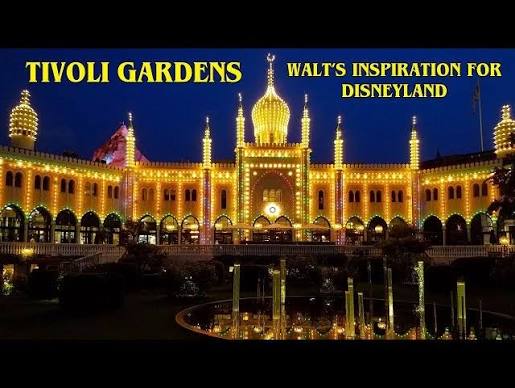
The connection between Tivoli and Disneyland is one of the most fascinating episodes in the history of international entertainment.
According to Tivoli Gardens’ official historical record, Walt Disney visited Tivoli in 1951, several years before Disneyland opened in California. Disney was fascinated by the atmosphere and charm of the Copenhagen gardens and wanted to understand what made the place so successful. Tivoli also notes that Disney visited the gardens both before and after Disneyland’s 1955 opening.
Disney was searching for something more ambitious than a traditional American amusement park.
He envisioned a place that would combine entertainment with storytelling, cleanliness, landscaping, architecture and carefully organized experiences.
Tivoli provided an important European example of how these elements could coexist.
Historical accounts of Disneyland’s development identify Tivoli among the places that influenced Disney’s thinking, alongside other American attractions and exhibitions.
The Danish influence should not be exaggerated into the claim that Disneyland was simply a copy of Tivoli — it was not. Disneyland emerged from numerous inspirations and from Disney’s own revolutionary approach to storytelling, cinema, animation, design and themed environments.
Nevertheless, Tivoli provided Disney with an important model of something he was trying to achieve: an amusement destination where atmosphere mattered as much as the individual attractions.
From Tivoli to Disneyland
When Disneyland opened in Anaheim, California, in 1955, it represented a major new stage in amusement-park history.
Traditional amusement parks and fairgrounds were generally organized around individual attractions. Disneyland instead presented visitors with interconnected themed environments.
Disney’s guests entered a carefully constructed world.
Architecture, landscaping, music, employees, attractions and visual details worked together to sustain particular stories and atmospheres.
This was the great innovation of Disneyland: the amusement park became a storytelling medium.
Yet when the Danish and American traditions are compared, fascinating similarities emerge.
Tivoli had already demonstrated that a successful pleasure garden could combine architecture, gardens, music, dining, performance and amusement. It had shown that adults and children could enjoy the same destination for different reasons. It had demonstrated the commercial and emotional value of beauty, atmosphere and careful maintenance.
Disneyland systematized these principles and combined them with Hollywood storytelling on an unprecedented scale.
Bakken, Tivoli and Disneyland: Three Different Visions
The three parks can be understood as three stages in the evolution of public entertainment.
Bakken represents the ancient popular tradition. It emerged naturally from crowds gathering around a spring and evolved over centuries through fairs, merchants, performers, restaurants and eventually mechanical rides.
Tivoli represents the nineteenth-century pleasure garden transformed into a sophisticated urban entertainment environment. Architecture, nature, culture, food and amusement were deliberately combined to create an experience.
Disneyland represents the twentieth-century themed environment, where entertainment was reorganized around storytelling and immersive fictional worlds.
Their histories are different, but they share an important principle: people do not visit amusement parks solely to ride machines.
They go there to temporarily enter another world.
Denmark Before Disney
This chronology puts Denmark in an extraordinary position in amusement history.
Bakken began in 1583.
Tivoli Gardens opened in 1843.
Disneyland opened in 1955.
That means Bakken’s origins precede Disneyland by more than 370 years, while Tivoli welcomed visitors more than a century before Disneyland.
This does not mean that Denmark invented every component of the modern theme park. Fairs, pleasure gardens, exhibitions, circuses and mechanical amusements developed in many countries over centuries.
But Denmark preserves two exceptionally important milestones in that evolution.
Bakken is recognized as the world’s oldest operating amusement park, while Tivoli became an internationally influential example of how amusement, gardens, architecture and cultural entertainment could be integrated into a coherent destination.
Two Danish Philosophies of Entertainment
Another remarkable aspect of the Danish story is how different Bakken and Tivoli are from one another.
Bakken developed from nature and popular tradition.
Tivoli developed from design and urban culture.
Bakken is hidden among the trees of Dyrehaven. Tivoli stands in central Copenhagen.
Bakken’s historical character emerged from merchants, entertainers and ordinary people gathering around a natural spring.
Tivoli’s character was deliberately cultivated through architecture, gardens, performance and visual spectacle.
One represents spontaneous popular culture; the other represents carefully designed cultural entertainment.
Yet both survived.
Their longevity suggests that successful amusement parks depend upon more than technological novelty. Roller coasters can become obsolete and attractions can be replaced, but traditions, atmosphere and emotional attachment can endure for generations.
The Human Need for Wonder
There is something almost poetic about the history of Dyrehavsbakken.
The world’s oldest operating amusement park did not begin with an entertainment corporation. It began because people walked into a Danish forest in search of water.
Around that spring grew a community of visitors.
Around those visitors gathered merchants and performers.
From those gatherings developed an entertainment tradition that survived kings, wars, industrialization, technological revolutions and enormous changes in European society.
Centuries later, Tivoli refined the amusement experience into something more deliberately theatrical. Its lights, gardens, architecture and performances transformed entertainment into atmosphere.
Then Walt Disney and his collaborators carried the concept of immersive entertainment into a new era, combining amusement with cinematic storytelling and creating a model that would profoundly influence global popular culture.
From a Danish Forest to the Magic Kingdom
The history of amusement parks therefore cannot be told solely through twentieth-century America.
Long before Mickey Mouse welcomed visitors to California, Copenhageners were already travelling to Dyrehaven for entertainment. Long before Disneyland’s Main Street, U.S.A., Tivoli had demonstrated how architecture, landscaping, restaurants, performances, illumination and attractions could combine to transport visitors away from ordinary life.
Disneyland revolutionized the industry, but it entered a tradition that was already centuries old.
And within that tradition, Denmark occupies an exceptional place.
Dyrehavsbakken represents its oldest surviving roots. Tivoli Gardens represents one of its great transformations. Disneyland represents the moment when immersive themed entertainment became a global cultural phenomenon.
Together, they form an extraordinary historical line stretching from a sixteenth-century Danish spring, through the illuminated gardens of nineteenth-century Copenhagen, to the fantasy kingdoms of twentieth-century California.
Perhaps the greatest achievement of these parks is therefore not any particular roller coaster, carousel or attraction.
It is their ability to preserve something fundamentally human: the desire to leave ordinary life behind for a few hours and enter a world devoted to imagination, laughter and wonder.
More than four centuries after visitors first gathered around Kirsten Piil’s spring, that desire remains as powerful as ever.
Sources
- Dyrehavsbakken — Official Website:
Bakken — English information and history
Official information about Dyrehavsbakken, its foundation in 1583, historic character and present-day attractions. (bakken.dk)
- Dyrehavsbakken — Historical Overview:
Dyrehavsbakken — Wikipedia
Background information concerning Kirsten Piil’s spring, the development of the entertainment tradition and Bakken’s status as the world’s oldest operating amusement park. (Wikipedia)
- Express — History of the World’s Oldest Amusement Park:
Express — Dyrehavsbakken in Denmark - Tivoli Gardens — Official History:
Tivoli Gardens — The History of Tivoli Gardens
Official chronology covering Tivoli’s foundation by Georg Carstensen in 1843, its cultural development and Walt Disney’s visits to the Copenhagen gardens. (Tivoli)
- Danish Architecture Center — Tivoli and Danish Identity:
Danish Architecture Center — Tivoli: Part of the National Identity
An architectural and cultural perspective on Tivoli’s place within Copenhagen and Danish national identity. (Dansk Arkitektur Center – DAC).
© 2026, DetectivPress. Toate drepturile rezervate.