Danish historian, Sven Aggesen, undertook the remarkable task of preserving the memory of his country’s kings and their achievements. Although his contemporary Saxo Grammaticus would eventually achieve greater international recognition, Aggesen remains one of the most significant historian of Danish historical literature. His writings offer invaluable insights into the origins of the Danish monarchy, the development of royal authority and the political identity of medieval Denmark.
Sven Aggesen was born around 1140–1150, during a period of considerable political instability and dynastic rivalry in medieval Denmark.
The precise date and place of his birth remain unknown, and historians possess relatively little information about his personal life.
Nevertheless, surviving historical evidence indicates that he belonged to the influential Danish aristocratic family known as the Trund or Thrugot lineage.
This distinguished family maintained close connections with both the Danish monarchy and the medieval Church.
Among its prominent members were Asser and Eskil, the first two archbishops of Lund.
Archbishop Eskil, who held his position from 1137 until 1177–1178, was Sven Aggesen’s uncle.
Such family connections placed the future historian within the intellectual, political and religious circles of the Danish elite.
During the twelfth century, education was largely controlled by ecclesiastical institutions, and aristocratic families frequently sent their sons abroad to receive advanced instruction.
Modern historians believe that Aggesen probably studied in northern France, one of medieval Europe’s most important centres of theological, philosophical and literary education.
Although direct documentary confirmation of his studies has not survived, his sophisticated Latin and familiarity with classical literature suggest that he received an education of considerable quality.
His writings reveal a man who understood not only Danish political traditions but also the literary conventions of medieval European historiography.
He belonged to a generation of educated Scandinavians who helped integrate the intellectual culture of Northern Europe into the broader Latin Christian world.
Denmark During the Twelfth Century: A Kingdom in Transformation
To understand Sven Aggesen’s historical importance, it is essential to examine the political environment in which he lived.
The twelfth century represented a decisive stage in the consolidation of the Danish monarchy.
Following years of internal conflicts and struggles for succession, Denmark gradually emerged as a more centralised kingdom.
The Danish civil wars, which lasted from 1131 until 1157, weakened royal authority and divided influential aristocratic families.
The political situation changed significantly when Valdemar I, commonly known as Valdemar the Great, became the sole ruler of Denmark in 1157.
His reign, lasting until 1182, marked an important period of political consolidation, military expansion and institutional development.
Working closely with Archbishop Absalon, Valdemar strengthened royal authority and promoted the expansion of Danish influence in the Baltic region.
The monarchy also sought to reinforce Denmark’s political independence in relation to the Holy Roman Empire.
These developments shaped the historical consciousness of Sven Aggesen.
His writings reflect an intellectual environment in which the preservation of royal history was closely connected to the legitimisation of political authority.
For Aggesen, recording the deeds of Danish rulers was not merely an academic exercise.
It was also a means of demonstrating the antiquity, continuity and independence of the Danish kingdom.
Sven Aggesen: Soldier, Cleric and Historian
One of the most fascinating aspects of Sven Aggesen’s biography is his involvement in both intellectual and military activities.
Unlike the modern historian, whose work generally takes place in libraries, universities and archives, Aggesen lived close to the political and military events he described.
Historical evidence suggests that he was associated with the royal households of Valdemar I and his successor, Canute VI.
He also maintained connections with Archbishop Absalon, one of the most influential figures in medieval Danish history.
Aggesen himself indicated that he participated in military expeditions against the Wends, particularly during the campaigns of 1184 and 1185.
The Wends were Western Slavic populations inhabiting territories along the southern Baltic coast.
During the twelfth century, Danish rulers conducted several military campaigns against these communities, combining territorial ambitions with Christian missionary objectives.
Aggesen’s participation in these expeditions gave him direct experience of the political and military environment of his time.
His perspective was therefore different from that of historians who depended exclusively on inherited manuscripts and oral traditions.
He could combine accounts of the distant past with personal knowledge of contemporary events.
Scholars also consider it likely that he belonged to the cathedral chapter of Lund, which was then one of the most important ecclesiastical and intellectual centres of the Danish realm.
Lund, situated in the historical province of Scania, belonged to Denmark during the Middle Ages, although the city is located in present-day Sweden.
Its cathedral and ecclesiastical institutions played an essential role in the development of Danish medieval scholarship.
Brevis Historia Regum Dacie: A Short History with Extraordinary Significance
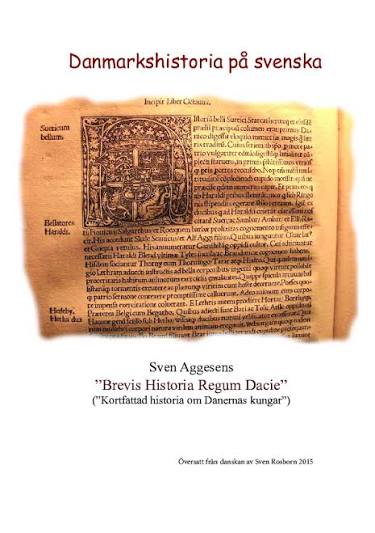
Sven Aggesen’s most celebrated work is Brevis Historia Regum Dacie, generally translated as A Short History of the Kings of Denmark.
The work is also known under the Latin title Compendiosa Regum Daniae Historia.
It was probably completed shortly after 1185, although the precise date remains uncertain.
Despite its relatively modest length, the chronicle represents a major achievement in medieval Danish historical writing.
Written in Latin, the international scholarly language of medieval Western Europe, it presents a concise account of Danish kingship from its legendary beginnings to the reign of Canute VI.
The narrative begins with Skjold, a legendary founder associated with the earliest Danish royal dynasty.
It subsequently moves through the stories of ancient rulers, the introduction of Christianity and the development of the medieval monarchy.
Unlike later historical works that attempted to provide extensive chronological narratives, Aggesen concentrated on selected events and personalities.
His writing combines historical traditions, legendary narratives, political interpretation and literary sophistication.
The chronicle was intended to preserve the memory of Danish rulers while presenting the kingdom as an ancient and politically independent community.
Its significance lies not only in the information it contains but also in the intellectual ambition behind its composition.
At a time when historical writing was still developing in Scandinavia, Aggesen attempted to construct a coherent narrative of Denmark’s royal past.
His work became one of the earliest substantial examples of Danish historical literature.
From Legendary Kings to the Christian Monarchy
The opening chapters of Aggesen’s chronicle explore the legendary origins of Danish kingship.
Among the figures appearing in his narrative are King Skjold, King Vermund and the heroic Uffe.
These personalities belong to traditions in which historical memory and legend are closely intertwined.
The story of King Vermund and his son Uffe is particularly significant.
According to the medieval tradition, Uffe defended the honour and independence of the Danish kingdom against foreign challengers.
The episode symbolises courage, loyalty and the determination to preserve political autonomy.
Aggesen uses such narratives to present Denmark as a kingdom whose independence had been defended since ancient times.
Another important figure is Queen Thyra, traditionally associated with the defensive fortifications of Danevirke.
Danevirke was a major system of defensive earthworks in southern Jutland, developed and expanded over several historical periods.
Medieval traditions attributed aspects of its construction or reinforcement to prominent rulers, including Queen Thyra.
Modern archaeology, however, demonstrates that the fortifications developed over centuries, meaning that legendary accounts cannot be treated as literal descriptions of their origins.
Nevertheless, Aggesen’s treatment of these traditions remains valuable.
His chronicle reveals how medieval Danish elites understood their country’s past and how they connected legendary ancestors with contemporary political ambitions.
The historical value of the text therefore extends beyond factual chronology.
It provides evidence of the political ideals, collective memories and cultural narratives circulating in twelfth-century Denmark.
Christianity and the Transformation of Danish Kingship
A substantial part of Aggesen’s chronicle concerns the development of Denmark as a Christian kingdom.
The conversion of Denmark was a gradual historical process extending across several generations.
King Harald Bluetooth, who ruled during the tenth century, occupies a particularly important place in this transformation.
He is traditionally associated with the official adoption of Christianity and the political consolidation of the Danish kingdom.
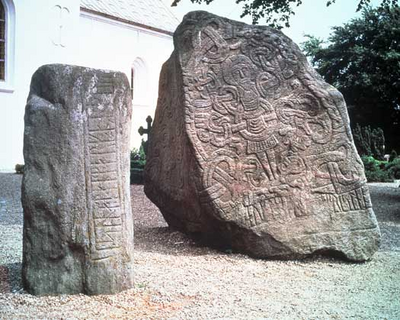
The famous Jelling monuments, including the great runestone erected by Harald Bluetooth, remain among the most significant surviving testimonies to this period.
For medieval historians such as Aggesen, the introduction of Christianity represented a major turning point.
It connected Danish kingship with the broader political and religious structures of medieval Europe.
Aggesen also devoted attention to King Canute IV, commonly known as Canute the Holy, who ruled from 1080 until his death in 1086.
Canute’s assassination and subsequent recognition as a saint became central elements of medieval Danish religious and political identity.
Another important personality in Aggesen’s narrative is Canute Lavard, the father of Valdemar the Great.
Canute Lavard was murdered in 1131 and later canonised in 1169.
His memory contributed to the legitimacy and prestige of the Valdemarian dynasty.
Through these accounts, Aggesen connected the history of the Danish monarchy with the development of Christian institutions and royal sanctity.
His chronicle thus reflects the close relationship between political authority and religious culture in medieval Denmark.
Valdemar the Great: The Architect of a Stronger Danish Kingdom
One of the central figures in Sven Aggesen’s historical interpretation is Valdemar I.
Aggesen admired the king’s achievements and presented his reign as an important stage in Denmark’s political development.
Valdemar’s government strengthened the monarchy after decades of civil conflict.
His military campaigns expanded Danish influence in the Baltic region, while his cooperation with Archbishop Absalon reinforced the relationship between royal and ecclesiastical institutions.
Aggesen particularly emphasised three achievements associated with Valdemar’s reign.
The first was the subjugation and Christianisation of the Slavic inhabitants of Rügen.
The second was the establishment of a permanent defensive position on the island of Sprogø, contributing to security in the Great Belt.
The third was the reinforcement of Danevirke through the construction of a brick wall.
These accomplishments represented military strength, territorial security and political organisation.
In Aggesen’s interpretation, Valdemar was not simply a successful warrior.
He was a ruler who strengthened the institutions and independence of the Danish kingdom.
This emphasis reveals the political purpose of Aggesen’s historical writing.
The chronicle sought to demonstrate continuity between Denmark’s legendary defenders and the powerful monarchy of the twelfth century.
Lex Castrensis: An Important Contribution to Danish Legal History
Sven Aggesen’s literary activity was not limited to royal history.
He also produced a Latin adaptation of the Danish royal household law known as Vederloven.
His work is generally referred to as Lex Castrensis, or Lex Castrensis sive Curiae.
The text concerns the regulations governing the king’s military household and aristocratic retainers.
In medieval Denmark, the royal household was more than a domestic institution.
It represented an important political and military structure through which the king maintained relationships with influential warriors and noble families.
The rules associated with the royal household addressed questions of loyalty, discipline, hierarchy and punishment.
Aggesen’s Latin treatment of these traditions provides important evidence for the study of medieval Danish legal culture.
It also demonstrates his interest in the relationship between historical memory and institutional authority.
By presenting royal regulations within a learned Latin framework, he contributed to the preservation and interpretation of traditions associated with Danish kingship.
Modern historians nevertheless approach the text critically.
Its account of the origins of the regulations cannot automatically be accepted as an accurate description of eleventh-century legal practice.
Like other medieval historical texts, it reflects the intellectual and political concerns of the period in which it was written.
Sven Aggesen and Saxo Grammaticus: Two Historians, One Kingdom
The relationship between Sven Aggesen and Saxo Grammaticus represents one of the most intriguing chapters in medieval Danish historiography.
Both historians were active during the late twelfth century.
Both wrote in Latin.
Both were connected to the political and ecclesiastical circles surrounding the Danish monarchy.
And both sought to preserve and interpret the history of Denmark.
However, their literary approaches differed considerably.
Aggesen preferred a relatively concise historical narrative.
Saxo Grammaticus undertook a much more extensive literary project that eventually became Gesta Danorum, or The Deeds of the Danes.
Saxo’s monumental history consists of sixteen books and covers Denmark’s legendary beginnings through the political developments of the late twelfth century.
Its literary ambition, extensive narrative structure and sophisticated Latin contributed to its lasting reputation.
Aggesen’s shorter chronicle, by contrast, concentrated on selected rulers and events.
An especially important detail is that Aggesen explicitly mentioned Saxo in his own historical work.
He explained that he would avoid discussing certain royal histories in greater detail because Saxo was already preparing a more extensive account based on information supplied by Archbishop Absalon.
This reference provides valuable evidence concerning the development of Saxo’s historical project.
It also demonstrates that the two historians were aware of one another’s literary activities.
Although Saxo eventually overshadowed Aggesen in historical reputation, the latter’s contribution remains independent and significant.
His chronicle offers a different perspective on the Danish monarchy and its political development.
Modern scholarship recognises that comparing the two authors can reveal differences in historical interpretation, literary technique and political emphasis.
For example, Aggesen gives considerable prominence to Valdemar the Great’s personal achievements, while Saxo’s narrative frequently places Archbishop Absalon at the centre of political and military developments.
Such differences remind historians that medieval chronicles were not neutral collections of facts.
They were carefully constructed narratives shaped by their authors’ experiences, loyalties and intellectual objectives.
A Medieval Historian’s Understanding of National Identity
One of the most important themes in Aggesen’s writings is the independence of the Danish kingdom.
His chronicle repeatedly emphasises the antiquity and continuity of Danish royal authority.
Stories involving conflicts with foreign powers reinforce the image of a people determined to defend their political autonomy.
This perspective reflected the concerns of twelfth-century Denmark, particularly its relationship with the Holy Roman Empire.
However, modern historians warn against interpreting Aggesen’s writings through the concept of nationalism as it developed during the nineteenth and twentieth centuries.
The political identity of medieval Europe differed fundamentally from modern national consciousness.
Loyalty was often directed towards rulers, dynasties, religious institutions and regional communities.
Aggesen’s historical narrative should therefore be understood primarily within the political and intellectual environment of the medieval Danish monarchy.
Nevertheless, his work contributed to the formation of a historical tradition through which later generations could imagine Denmark as a kingdom possessing an ancient and distinctive past.
His achievement was to connect legendary origins, royal genealogy, Christian history and contemporary political authority within a single literary narrative.
The Survival of Sven Aggesen’s Manuscripts
The survival of Aggesen’s writings is itself an important chapter in the history of Danish scholarship.
Unlike many medieval works preserved through numerous manuscripts, his texts have survived through a complicated and incomplete documentary tradition.
The original manuscripts have been lost.
Modern scholars depend on later copies and early printed editions, some of which contain significant textual differences.
An important early edition was published in 1642 by the Danish scholar Stephanus Johannis Stephanius.
The surviving textual evidence is difficult to interpret because of copying errors and possible editorial alterations.
The Copenhagen fire of 1728 also contributed to the destruction of important historical manuscript collections.
Consequently, modern editions of Aggesen’s works require careful textual reconstruction.
One of the most influential scholars involved in this process was Martin Clarentius Gertz.
His critical editions and Danish translations, published during the early twentieth century, helped establish the foundation for modern research into Aggesen’s writings.
Another important contribution appeared in 1992, when historian Eric Christiansen published The Works of Sven Aggesen, Twelfth-Century Danish Historian.
This scholarly edition and English translation made Aggesen’s writings more accessible to international researchers.
The complicated transmission of his texts also explains why historians must approach certain passages with caution.
Despite these difficulties, Aggesen’s surviving works remain indispensable sources for understanding medieval Danish historical consciousness.
Modern Academic Research: Preserving Denmark’s Medieval Intellectual Heritage
More than eight centuries after Sven Aggesen composed his historical writings, the study of medieval Danish literature continues to occupy an important place in academic research.
Among the institutions contributing to this field is the Saxo Institute at the University of Copenhagen.
The institute brings together historical and archaeological research, contributing to the broader investigation of Denmark’s past.
Its academic environment supports the study of historical sources, material culture and the development of societies across different periods.
Another particularly important institution is the Centre for Medieval Literature at the University of Southern Denmark.
Established in 2012 as a Centre of Excellence supported by the Danish National Research Foundation, the centre developed an international research programme in cooperation with the University of York.
Its original Centre of Excellence funding period ran from 2012 to 2022, but its research activities have continued at the University of Southern Denmark.
The centre investigates medieval literary cultures across Europe and their connections with broader Eurasian and Mediterranean traditions.
Its interdisciplinary approach combines literary studies, history, manuscript research and the study of intellectual networks.
Professor Lars Boje Mortensen, a prominent specialist in medieval Latin literature and historiography, has contributed extensively to research concerning Sven Aggesen and Saxo Grammaticus.
His studies examine the relationship between historical writing, political authority and the development of literary culture in medieval Denmark.
Such research has helped establish a more nuanced understanding of Aggesen’s contribution.
Rather than considering him merely a minor predecessor of Saxo, modern scholarship recognises his importance as an independent historian whose work reflects the political and intellectual ambitions of the Danish elite.
The continued investigation of medieval manuscripts, historical narratives and Latin literary traditions demonstrates the lasting relevance of Aggesen’s writings.
Why Sven Aggesen Still Matters Today
Sven Aggesen’s historical importance extends beyond the relatively small number of pages he left behind.
His writings preserve evidence of how educated Danes in the twelfth century understood their kingdom’s origins and political development.
They illuminate the relationship between monarchy and Church, the importance of aristocratic traditions and the emergence of more systematic historical writing in Scandinavia.
His chronicle also illustrates the intellectual transformation that accompanied Denmark’s integration into medieval European Christian culture.
By writing in Latin, Aggesen placed Danish history within a literary tradition shared by scholars throughout Western Europe.
His work demonstrates that Denmark was not an isolated northern kingdom but an active participant in the political, religious and intellectual developments of medieval Europe.
At the same time, his historical narratives reveal the limitations of medieval historiography.
Legends, dynastic interests and political interpretations frequently shaped the presentation of events.
Modern researchers must therefore distinguish between historical evidence and literary construction.
Yet these characteristics do not diminish Aggesen’s significance.
On the contrary, they make his writings valuable documents of medieval thought.
His chronicle tells us not only what medieval Danes believed had happened in their past, but also how influential members of Danish society wanted that past to be remembered.
Conclusion: The Historian Who Helped Give Denmark a Written Memory
Sven Aggesen occupies a distinguished position among the pioneers of Danish historical literature.
Born into an influential aristocratic family, educated within the intellectual traditions of medieval Europe and closely associated with the Danish monarchy, he witnessed a decisive period in the formation of the medieval Danish state.
His historical writings connected the legendary origins of Danish kingship with the political achievements of Valdemar the Great and Canute VI.
Through Brevis Historia Regum Dacie, he preserved stories, traditions and interpretations that remain important for understanding Denmark’s medieval identity.
His adaptation of Lex Castrensis also contributed to the documentation of early Danish legal and aristocratic institutions.
Although Saxo Grammaticus became the more celebrated historian, Aggesen deserves recognition as one of the earliest authors to construct a coherent literary account of Denmark’s royal past.
His achievements were particularly remarkable considering the limited documentary resources available to historians of his time.
More than eight hundred years later, his writings continue to attract scholarly attention.
They remain essential for understanding how medieval Denmark interpreted its origins, defended its political independence and established a historical tradition capable of connecting past and present.
Sven Aggesen did not merely record the deeds of Danish kings. He helped transform the memory of a medieval kingdom into a written historical legacy.
And although his name may be less familiar than that of Saxo Grammaticus, his contribution to Denmark’s cultural and intellectual heritage remains enduring.
SOURCES AND HISTORICAL REFERENCES
1. Lars Boje Mortensen — Sven Aggesen
Lex.dk — Danish National Encyclopedia
A scholarly biographical study examining Aggesen’s aristocratic origins, education, historical writings and relationship with Saxo Grammaticus.
2. Anders Bøgh — Svend Aggesen, ca. 1140–1200
Danmarkshistorien, Aarhus University / Lex.dk
Historical information concerning Aggesen’s life, military participation, literary activity and surviving works.
3. Lars Boje Mortensen — Sven Aggesens kongehistorie
Dansk litteraturs historie
A detailed examination of the structure, literary characteristics and political interpretation of Aggesen’s royal chronicle.
Read the literary-historical study
4. Aarhus University — A Christian Danish Culture
An academic overview of the development of historical writing in medieval Denmark, including the contributions of Sven Aggesen and Saxo Grammaticus.
5. Karsten Christensen — Sven Aggesen
Dansk Biografisk Leksikon
Biographical research discussing Aggesen’s historical background, surviving manuscripts and early modern editions.
Danish Biographical Encyclopedia
6. Eric Christiansen — The Works of Sven Aggesen, Twelfth-Century Danish Historian
Viking Society for Northern Research, 1992.
An important scholarly edition containing English translations and commentary on Aggesen’s historical writings.
7. University of Southern Denmark — Centre for Medieval Literature
Information concerning contemporary academic research into medieval European literature, Latin historiography and manuscript traditions.
Centre for Medieval Literature
8. University of Copenhagen — Saxo Institute
Academic research into history, archaeology and related historical disciplines.
© 2026, DetectivPress. Toate drepturile rezervate.