
DAVIDE BORRUTO
Lawyer Davide Borruto, independent journalist, adjunct editor of the international art and culture magazine LE MUSE, published in 2002
Civil and criminal lawyer Baroul Reggio Calabria. Personal law, contract law, corporate law law, consumer law law, fiscal law law, family law law, insurance law, business law, financial recovery, money and criminal law
“AVOCAT expert in your life and will” – Avocat la Baroul Reggio Calabria (Italy)
Passionate about cinema and director.

After inventing the spaghetti western that would bring so much success to Italian cinema for nearly two decades, Sergio Leone decided to change genre, despite the fact that the Dollars Trilogy had grossed beyond all expectations and producers were pushing for the great Roman director to continue directing films dominated by gunslingers, huge loot, and epic music. Enticed by the prospect of directing two big names in Western cinema—Henry Fonda and Charles Bronson, whom he had unsuccessfully attempted to cast back when he made A Fistful of Dollars but who had declined the offer out of mistrust of the then-anonymous director—thanks to the resources provided by a major studio like Paramount, Leone began working on the project for what would become Once Upon a Time in the West, the first chapter of his second trilogy, known as the trilogy of time in reference to the titles of the films that comprise it (precisely, Once Upon a Time in the West, A Fistful of Dollars—the working title of which was Once Upon a Time in the Revolution—and Once Upon a Time in America).
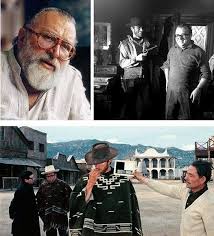
Another way to refer to these three films might be the trilogy of dreams, since the dreams, plans, ambitions, and desires of the characters who take turns on the scene dominate their respective plots. Not that in the previous trilogy, where the venal aspect is undoubtedly (and inevitably) prevalent (think of the lust for hegemony of the two families, Baxter and Rojo in A Fistful of Dollars, the robbery of the El Paso bank and the bounty on the Indio in For a Few Dollars More, and Bill Carlson’s search for the fabulous loot in The Good, the Bad and the Ugly), there isn’t, to some extent, room for these themes too: the revenge against the Indio who arms the hand of Colonel Mortimer, the corrupt relations between Tuco and his brother, or, again, the loyal friendship that develops between Silvanito and the foreign protagonist of A Fistful of Dollars, without forgetting the use of the flashback device, again in For a Few Dollars More, which the author will increasingly use in the three films, arriving at Once Upon a Time in America, where the flashback constitutes the most conspicuous part of the story.
Starting from the very feeling of revenge, it is this feeling that drives the actions of one of the protagonists of Once Upon a Time in the West, the unnamed character who somewhat echoes the role played by Clint Eastwood in the first trilogy, that of a mysterious and silent hero, whose only nickname is provided:
„Harmonica.” The film is the only one of the second trilogy that can easily be classified in a specific and precise genre, because we are still in the realm of the Western, albeit without the „spaghetti” genre. The dominant characters are the aforementioned Harmonica and the ambitious and unscrupulous Frank, as well as Cheyenne and the businessman Morton (symbolizing a category destined to replace the „old breed” of simple „men,” as Harmonica states in the duel that closes the film). The novelty of Once Upon a Time in the West lies in the importance and centrality of a female role, Jill, played with great effectiveness by Claudia Cardinale. Her dreams are both exalted and shattered, the hope of redeeming herself from a life of prostitution (which Frank scornfully reminds her of), as are those of McBain himself, eager to build a city of his own after years of sacrifice.
While the placement of Once Upon a Time in the West seems easy, the same cannot be said for its subsequent, troubled work, Duck, You Sucker! Originally intended to be directed by Sam Peckinpah, when the latter declined, Leone decided to direct it himself.
The film focuses on the Mexican Revolution (so much so that, as already mentioned, the title Once Upon a Time in the West was considered, retained for the French version, while in English-speaking countries the film was renamed A Fistful of Dynamite, to tie in with the director’s previous titles) and blends western, drama, political and social commentary, and adventure, with some touches of humor and Mexican history (key figures of the revolution such as Villa, Madero, Huerta, and Zapata are mentioned). If Bronson’s Harmonica seems to recall the Man with No Name from the first Leonian trilogy, played by Eastwood, Rod Steiger’s Juan Miranda seems like an evolution of Tuco (Eli Wallach in The Good, the Bad and the Ugly), and certainly not only because of the use of the same voice actor (the actor Carlo Romano, a legend of Italian dubbing) for the two characters. The film begins with a distinctly Western feel, with a classic stagecoach robbery that ends with the appearance of the other protagonist, John (played by James Coburn), who, however, arrives not on horseback (like any Eastwood), but on a moped. Having recognized John’s talent for explosives, Miranda sees in him the key to unlocking an old family dream: robbing the fabulous Mesa Verde bank. But John’s dreams are higher and deeper than those of the chicken thief Juan, being a bomber who fights alongside the revolutionaries (first Irish, now Mexican). The paths of the two seem irreconcilable, especially since Miranda hates revolutions, but events will lead the robber to collide with reality: the revolution has destroyed his dreams (the Mesa Verde bank has been transformed into a political prison ‒ no longer full of money, but of an army of starving people ‒ and his family ‒ made up of the elderly father and his six children, all had by different mothers as he is keen to clarify ‒ is massacred in an ambush by government troops) leading him to the same disillusionment as John who, due to the betrayal of his best friend (who, as we see in flashbacks, sold him and his companions, having them arrested and ‒ it is unclear ‒ whether he also took his woman away or their friendship was such as to lead them to peacefully share the same partner) now believes only in dynamite. Left without family and ambitions, Miranda tears the cross from her neck (in response to the fact that God, to whom she had entrusted her children before the ambush, did not save them) and faces death, being saved at the last moment by John, with whom she has now established a relationship of sincere friendship, as the final scenes of the film will testify.
Once Upon a Time in America is a project dating back at least fifteen years to its creation. Although several big-name actors were auditioned and considered, Leone had already chosen Robert De Niro to play Noodles in the 1970s, so much so that he had already discussed the film with the actor at the time. Leone’s latest work is perhaps his most ambitious, lengthy, most strongly desired, and also his longest (the director’s cut, released in 2012 after a meticulous restoration, clocks in at a whopping four hours and ten minutes). While it wasn’t a commercial success (the box office for the Dollars trilogy would far exceed that of the Time trilogy), over time critics and audiences have also come to appreciate this latest effort by the Roman director, which is ‒ once again ‒ a blend of genres. The dreamlike quality of Once Upon a Time in America is such that it leads the audience to wonder whether the events narrated actually happened or are the product of an opium-induced hallucination (although for various reasons this theory seems ultimately untenable). The author seems to return, at least in part, to the theme already explored in Once Upon a Time in the West, with reference to the advancement of interests to the point of prevailing over the honor and classic values of Western heroes (indeed, it is interests and the lust for power that contaminate the dream long shared by Noodles and Max ‒ played by James Woods ‒). But this work goes further, recounting almost the entire existence of the two protagonists, united by the desire not to bow before any master (a bit like the young Vito Corleone rebelling against Don Fanucci in The Godfather Part II) but divided by different passions, particularly Noodles’s near-obsession with Debora (Elizabeth McGovern), another of his dreams, shattered this time by his own hand by the violence he subjects her to when she refuses to start a life together, despite her admitting she loves him.
The Time Trilogy’s diverse genres and cast (despite the homogeneity found in the Dollars Trilogy, ensured by the presence of a core cast of actors such as Eastwood, Volontè, Van Cleef, and Brega) is accompanied, therefore, by a convergence and continuity of content: no longer money (or cigars), but, indeed, the dream, is the true protagonist.
© 2026, DetectivPress. Toate drepturile rezervate.