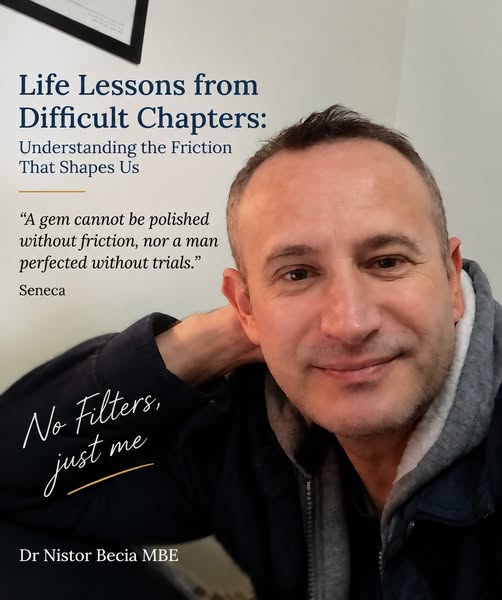
“A gem cannot be polished without friction, nor a man perfected without trials.”
Seneca
I came across this quote recently and it made me stop and reflect. 
Over the last few months, I have spoken with many people around me who are going through difficult periods in their lives. The circumstances are different, the stories are different, but there is often a common human experience: the feeling that life has become a continuous process of managing challenges, adapting to unexpected situations and trying to find meaning when things do not unfold in the way we hoped.
Although my professional role involves supporting people through some of the most complex and painful moments of their lives, I am not a stranger to these experiences myself. Like everyone else, I have faced moments when life has tested my resilience, my patience, my values and my understanding of what truly matters. 
Perhaps one of the hardest lessons we learn in life is accepting that difficulties are not always something we can avoid.
As human beings, we naturally search for explanations when we experience pain or uncertainty. We ask ourselves:
“Why is this happening to me?”
“Why now?”
“What did I do to deserve this?”
These questions are not signs of weakness. They are part of being human.
Psychologically, one of the most important processes during difficult times is the search for meaning. Research in psychology has shown that people often cope better with adversity when they are able to integrate their experiences into a meaningful personal story, rather than seeing themselves only as victims of circumstances.
Many people describe difficult experiences as fate.
But what is fate?
Is it something written for us, or is it sometimes the meaning we create as we try to understand events that have changed us?
The Swiss psychiatrist Carl Jung wrote extensively about the importance of becoming conscious of our own experiences and looking deeper within ourselves rather than simply accepting explanations without reflection. He believed that personal growth involves understanding all parts of ourselves, including the painful, uncomfortable and hidden aspects that we often try to avoid.
Jung described this lifelong process as individuation, the journey of becoming a more complete and authentic version of ourselves. It involves facing our inner conflicts, recognising our patterns and developing a deeper understanding of who we are.
When asked during his famous BBC Face to Face interview whether he believed in God, Jung replied:
“I know. I don’t need to believe. I know.”
For Jung, this was not about accepting ideas without questioning. It reflected his belief in personal experience, inner awareness and the importance of understanding rather than simply believing.
This does not mean that we should pretend every difficult experience has a hidden blessing, or that suffering should be romanticised.
Pain is real. Loss is real. Some experiences are deeply unfair and can leave lasting marks.
However, perhaps the questions we ask ourselves can change. 
Instead of only asking:
“Why is this happening to me?”
we can sometimes ask:
 “What can I learn from this experience?”
“What is this moment showing me about myself?”
“How can I grow through this, rather than only suffer because of it?”
In psychology, resilience is often misunderstood. Resilience is not about never struggling. It is not about pretending everything is fine or carrying everything alone.
Resilience is the ability to adapt, to seek support, to remain connected with our values and to continue moving forward despite adversity.
A stone is polished through friction.
A person is often shaped through experiences that challenge them.
The difficult chapters of our lives are rarely the chapters we would choose. However, they are sometimes the chapters where we discover our strength, our values and parts of ourselves that we may never have encountered otherwise.
To anyone who is currently going through a difficult period:
Be patient and compassionate with yourself.
Struggling does not mean you are failing.
Sometimes the experiences we would most like to avoid become the ones that help us understand ourselves, others and life in a deeper way.
The friction may be uncomfortable, but sometimes it is also what creates the polish.
Dr Nistor Becia MBE
© 2026, DetectivPress. Toate drepturile rezervate.