In Denmark, charity does not need a stage, an audience or religious spectacle to demonstrate its value. Behind the modest doors of thousands of second-hand initiatives and hundreds of charitable shops lies an extraordinary tradition of solidarity, volunteering and social responsibility. Here, generosity is often substantial but discreet, and helping others is understood as a natural expression of humanity rather than an opportunity for public recognition.

Denmark is internationally recognised for its high standard of living, social welfare system, democratic institutions and commitment to environmental sustainability. However, beyond these familiar characteristics lies another remarkable dimension of Danish society: its deeply rooted culture of volunteering and practical solidarity.
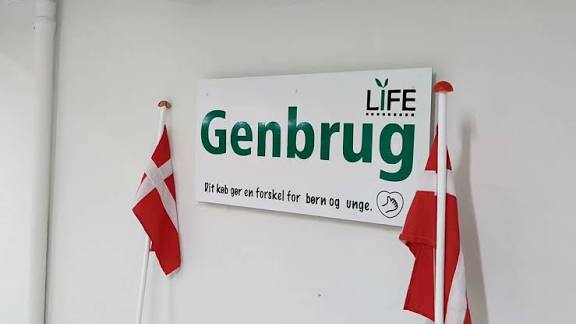
Across Danish towns and cities, charity shops known as genbrugsbutikker have become an integral part of everyday life.
The Danish word genbrug means reuse or recycling, while genbrugsbutik refers to a second-hand shop.
These establishments sell donated clothing, furniture, household objects, books, toys and numerous other products at affordable prices. Yet their importance extends far beyond ordinary commercial activity.
Many of these shops operate under the administration of humanitarian and charitable organisations, including the Danish Red Cross (Røde Kors), DanChurchAid (Folkekirkens Nødhjælp), the Church Army (Kirkens Korshær) and Danmission.
Although these organisations have different histories, identities and charitable priorities, they share a fundamental objective: transforming donated goods, voluntary labour and community participation into practical assistance for people experiencing hardship.
Their activities illustrate a distinctive feature of Danish social culture.
Charity is not necessarily measured by the visibility of the donor, the solemnity of a religious ceremony or the publicity surrounding a charitable gesture. Instead, its value is frequently demonstrated through continuity, organisation, efficiency and tangible results.
In Denmark, generosity can be remarkably substantial while remaining discreet.
The Historical Origins of Charity Shops in Denmark
The development of organised charity shops in Denmark is closely connected to the humanitarian initiatives that expanded during the twentieth century.
Although second-hand trading and informal reuse existed long before, the modern Danish charity-shop movement emerged in the early 1970s.
An important historical milestone occurred in 1972, when the Christian humanitarian organisation Folkekirkens Nødhjælp, internationally known as DanChurchAid, established what it identifies as Denmark’s first charity shop.
The initiative originated with the Danish couple Ruth and Herluf Andersen, who had encountered the British charity-shop model during a visit to the humanitarian organisation Oxfam.
Inspired by the possibility of transforming donated clothing and household objects into financial resources for people living in poverty, the couple decided to introduce a similar concept in Denmark.
Their first shop opened in Grønnegade, Aarhus, before relocating shortly afterwards to Gammel Munkegade.
What began as a modest humanitarian initiative eventually developed into an extensive national network.
The underlying principle was both simple and revolutionary: objects that had lost their usefulness to one person could acquire new value for another, while the money generated from their sale could support people in need.
This approach connected economic practicality with humanitarian responsibility.
It also challenged the traditional perception of second-hand goods.
For generations, purchasing used clothing had often been associated with financial necessity. Gradually, however, Danish charity shops helped transform reuse into an accepted and increasingly attractive social practice.
Today, second-hand shopping is associated not only with affordability but also with sustainability, individuality and responsible consumption.
The transformation reflects broader changes in Danish society, where environmental awareness and social responsibility increasingly influence consumer behaviour.
Røde Kors: A Humanitarian Tradition Dating Back to the Nineteenth Century
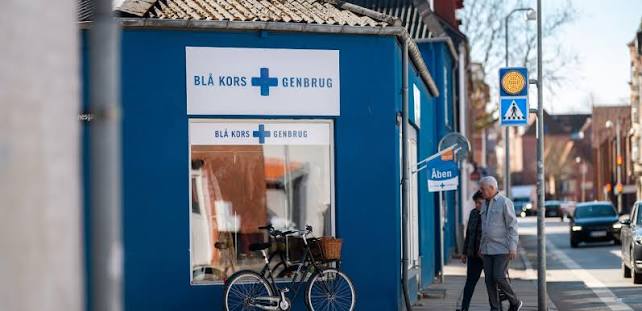
Among Denmark’s most prominent humanitarian organisations is Røde Kors, the Danish Red Cross.
Its origins are connected to the international Red Cross movement, inspired by the Swiss humanitarian Henry Dunant following the Battle of Solferino in 1859.
The suffering of wounded soldiers encouraged Dunant to advocate organised assistance that would transcend national, political and religious divisions.
The Danish Red Cross was formally established on 27 April 1876 under the name Foreningen af syge og såredes pleje under krigsforhold, an association dedicated to caring for sick and wounded people during wartime.
During its early decades, the organisation concentrated on nursing education, first aid and humanitarian assistance.
Over time, its responsibilities expanded considerably.
Today, Røde Kors provides assistance to vulnerable individuals and communities in Denmark while also participating in international humanitarian operations involving armed conflicts, natural disasters, displacement and other emergencies.
Its activities are guided by the fundamental principles of the international Red Cross movement, including humanity, impartiality, neutrality, independence and voluntary service.
These principles are especially important because humanitarian assistance is provided according to human need rather than religious affiliation or political identity.
The organisation’s charity shops represent one of its most visible connections with Danish everyday life.
From a Small Shop in Aars to a Nationwide Humanitarian Network
The first Danish Red Cross second-hand shop opened in 1975 in Aars, a town in northern Jutland.
This initiative marked the beginning of a remarkable expansion.
Over the following decades, Røde Kors developed an extensive network of shops supported by thousands of volunteers.
According to the organisation’s published information, its second-hand activities generated revenue of approximately DKK 325 million in 2025, producing a surplus of DKK 103 million for humanitarian work.
The network comprises more than 260 shops across Denmark, supported by approximately 11,000 volunteers.
These figures demonstrate that charitable reuse is not a marginal activity. It is a significant source of funding for humanitarian assistance.
The volunteers perform numerous essential responsibilities.
They receive donations, sort clothing, evaluate the condition of merchandise, organise shelves, arrange displays, assist customers and manage daily shop operations.
Some participate for a few hours each week, while others dedicate many years to the organisation.
Their contribution represents an extraordinary investment of time, effort and personal commitment.
Unlike conventional commercial businesses, these shops depend heavily on unpaid voluntary participation.
The financial surplus generated by their activities helps support social programmes in Denmark and humanitarian assistance internationally.
Consequently, an ordinary purchase of a second-hand jacket, a chair or a book can become part of a much larger humanitarian process.
A donated object becomes a source of income.
That income becomes practical assistance.
And practical assistance can improve or even save human lives.
Charity That Crosses National Borders
The humanitarian importance of Danish charity shops becomes particularly evident when examining how their financial resources are used.
Røde Kors supports vulnerable families, people experiencing loneliness, refugees, migrants and individuals facing difficult social circumstances.
Internationally, its humanitarian work responds to crises involving displacement, conflict and natural disasters.
According to the organisation’s financial information, in 2025 the Danish Red Cross carried out international humanitarian activities worth approximately DKK 1.09 billion and reported assisting approximately 4.78 million people internationally.
These figures refer to the organisation’s broader humanitarian activities, not exclusively to income generated by second-hand shops.
Nevertheless, the contribution of charity shops remains an important part of its financial foundation.
Another significant characteristic of the Danish model is the emphasis on using resources efficiently.
Røde Kors explains that selling donated clothing and using the resulting income to purchase necessary supplies locally can sometimes be more effective than transporting the original clothing across international borders.
Such an approach can reduce unnecessary transportation costs while supporting local economies.
It also allows humanitarian organisations to respond to changing needs.
A community affected by conflict may require blankets during winter, while another emergency may demand medicine, food or shelter.
The objective is not merely to distribute donated objects but to provide assistance appropriate to the circumstances.
This pragmatic philosophy is central to understanding the effectiveness of Danish humanitarian organisations.
Kirkens Korshær: Helping the Most Vulnerable Members of Society
Another major organisation operating charity shops throughout Denmark is Kirkens Korshær, commonly translated as the Church Army.
Unlike the Danish Red Cross, Kirkens Korshær has an explicitly Christian institutional identity.
Its charitable activities focus particularly on people experiencing homelessness, poverty, loneliness, addiction and severe social exclusion.
The organisation operates an extensive network of approximately 230 second-hand shops across Denmark.
Its activities depend on thousands of volunteers who contribute to collecting, preparing and selling donated merchandise.
The proceeds help finance social programmes designed to assist some of the most vulnerable members of Danish society.
These initiatives include support for people without stable housing, individuals living in poverty and those experiencing profound social isolation.
Kirkens Korshær also operates shelters and other social services.
Its work demonstrates how an organisation with Christian foundations can express its religious values primarily through practical humanitarian assistance.
The emphasis is placed on meeting human needs.
A person requiring food, warmth, shelter or companionship does not necessarily need a public religious ceremony.
What that individual needs is effective assistance, delivered with respect and dignity.
This distinction is essential when examining the relationship between religion and charity in Denmark.
Christian inspiration does not automatically imply religious theatricality.
In many Danish charitable institutions, religious heritage and practical social responsibility coexist without requiring beneficiaries to participate in public demonstrations of faith.
DanChurchAid: From Christian Compassion to International Development
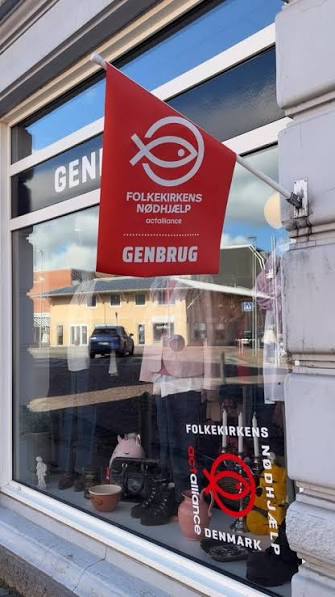
Folkekirkens Nødhjælp, internationally known as DanChurchAid, occupies a particularly important place in the history of Danish charity shops.
Its pioneering initiative in Aarhus in 1972 helped establish the modern Danish charitable second-hand sector.
Over the decades, the organisation developed more than 100 charity shops supported by volunteers.
Its published information describes annual shop surpluses of approximately DKK 25–27 million, depending on the reporting period.
These resources contribute to humanitarian assistance and development programmes benefiting people affected by poverty, emergencies and other difficult circumstances.
The organisation’s Christian origins remain an important part of its institutional identity.
However, its humanitarian activities extend beyond Denmark and address the needs of people belonging to different cultures and religious traditions.
Its charity-shop model illustrates how religiously inspired solidarity can operate through modern, organised and internationally oriented humanitarian programmes.
The original idea introduced by Ruth and Herluf Andersen has therefore acquired historical significance far beyond its modest beginnings.
Their initiative helped create a lasting relationship between Danish households, voluntary organisations and communities requiring assistance around the world.
Danmission: Two Centuries of Institutional History and Decades of Reuse
Danmission represents another significant example of the relationship between Christian heritage, volunteering and charitable commerce.
Its historical roots date back to 1821, when the Danish Missionary Society was established.
The present organisation emerged in 2000 through the merger of the Danish Missionary Society and the Danish Santal Mission.
Its second-hand activities began in 1977, inspired by Niels Iver Brogaard Andersen, who recognised the potential of reuse as a means of supporting humanitarian and missionary activities.
The organisation subsequently developed a network of charity shops throughout Denmark.
According to its published information, Danmission operates more than 60 shops with the participation of over 2,000 volunteers.
These establishments provide financial support for the organisation’s international activities while also creating meaningful social communities within Denmark.
Volunteers work together, develop friendships, share responsibilities and contribute to objectives extending beyond their individual lives.
This social dimension is particularly important.
For some volunteers, participation offers an opportunity to remain active after retirement.
For others, it creates a sense of belonging and connection with their local community.
Thus, charity shops contribute not only to international assistance but also to the social wellbeing of the people who operate them.
Danish Generosity: Substantial, Consistent and Discreet
Perhaps the most interesting aspect of Denmark’s charitable culture is not simply the amount of money generated by humanitarian organisations.
It is the manner in which charitable participation has become integrated into ordinary life.
A Danish resident may donate clothing without expecting public recognition.
A retired person may volunteer several hours every week without considering the activity extraordinary.
A customer may purchase second-hand furniture because it is practical, affordable and environmentally responsible, while simultaneously contributing to humanitarian assistance.
These gestures are often performed without elaborate ceremonies or public declarations of personal virtue.
In this respect, Danish charitable culture offers an interesting contrast with certain practices found in other societies with strong Christian traditions.
In some countries, charitable activities are occasionally accompanied by highly visible religious ceremonies, public displays of donations, prominent recognition of benefactors or events in which generosity becomes closely associated with institutional prestige.
Such practices are not necessarily insincere. Public charitable events can mobilise resources, inspire participation and draw attention to important social problems.
However, they can also raise questions about the relationship between genuine solidarity, religious symbolism and the desire for public recognition.
The Danish model frequently presents a different emphasis.
Rather than transforming charity into a religious spectacle, many Danish organisations integrate it into ordinary civic participation.
The act of helping becomes more important than the public image of the person providing assistance.
The dignity of the beneficiary is valued above the visibility of the donor.
And the effectiveness of humanitarian action matters more than ceremonial recognition.
This should not be interpreted as suggesting that all Danish charitable activities are anonymous or that Danish organisations avoid publicity.
Fundraising campaigns, public appeals and promotional initiatives remain important parts of humanitarian work in Denmark.
Nor should it imply that charity in other Christian societies is generally motivated by appearances.
Discreet and sincere generosity exists across religious traditions and national cultures.
Nevertheless, the Danish experience demonstrates that large-scale charitable activity can function successfully without relying primarily on religious spectacle or the public glorification of individual benefactors.
Its most compelling expression is often found in the ordinary continuity of voluntary service.
Christianity, Secular Society and the Ethics of Helping Others
Denmark’s charitable culture is especially interesting because the country combines a strong historical connection with Lutheran Christianity and a highly secularised contemporary society.
The Evangelical Lutheran Church remains an important institution in Danish history and cultural identity.
At the same time, many aspects of public life are organised around secular democratic values, individual freedom and social responsibility.
This combination has influenced the development of Danish humanitarian institutions.
Some charitable organisations are explicitly Christian.
Others, such as Røde Kors, operate according to internationally recognised principles of neutrality and impartiality.
Despite these institutional differences, their practical activities often converge around shared humanitarian objectives.
They seek to reduce suffering, provide assistance and strengthen social solidarity.
The religious background of an organisation does not necessarily determine the religious identity of the people it helps.
Similarly, volunteers may participate for different reasons.
Some are motivated by Christian beliefs.
Others are inspired by humanitarian values, environmental concerns, community engagement or a personal desire to contribute to society.
This diversity is one of the strengths of the Danish voluntary sector.
It allows people with different convictions to cooperate in pursuit of common objectives.
In such an environment, charity becomes a bridge between religious tradition and secular civic responsibility.
The Relationship Between Charity and Environmental Sustainability
Another distinctive characteristic of Danish charity shops is their contribution to environmental sustainability.
By encouraging the reuse of clothing, furniture and household goods, these establishments help extend the useful life of existing products.
Every item reused represents an opportunity to reduce demand for new resources.
Second-hand shopping can therefore contribute to lowering waste and reducing some of the environmental pressures associated with production and consumption.
In Denmark, environmental awareness has helped transform charity shops into attractive destinations for a wide range of customers.
They are no longer associated exclusively with economic hardship.
Students, families, pensioners, environmentally conscious consumers and people interested in vintage fashion regularly explore second-hand shops.
Some customers are searching for inexpensive necessities.
Others appreciate the individuality of older furniture, books, clothing and decorative objects.
Many are attracted by the possibility of combining responsible consumption with humanitarian support.
This creates a particularly effective relationship between ecological and social objectives.
The same transaction can benefit the customer, support charitable activities and reduce unnecessary consumption.
Charity and sustainability become mutually reinforcing principles.
The Invisible Contribution of Volunteers
Behind the financial achievements of Denmark’s charitable second-hand sector lies an immense contribution that cannot be measured solely in monetary terms.
It is the contribution of volunteers.
Thousands of people dedicate their time to sorting donations, cleaning furniture, organising merchandise, assisting customers and maintaining the daily operation of shops.
Many perform these activities quietly and consistently for years.
Their work rarely attracts national attention.
They are not necessarily celebrated as public benefactors.
Yet without their participation, the charitable shop networks would struggle to generate the financial resources upon which numerous humanitarian programmes depend.
The significance of their contribution becomes especially apparent when considering the collective results.
A few hours of voluntary work may appear modest when viewed individually.
Multiplied across thousands of volunteers and hundreds of shops, however, these contributions create an extraordinary humanitarian infrastructure.
This is one of the most powerful lessons offered by the Danish model.
Social transformation does not always require exceptional individual gestures.
It can emerge from the accumulation of ordinary acts performed consistently over time.
Charity Without Humiliation: The Importance of Human Dignity
A further consideration concerns the dignity of people receiving humanitarian assistance.
Charitable activities can become problematic when beneficiaries are publicly exposed, photographed or presented primarily as objects of pity.
Although public awareness campaigns sometimes require personal testimonies, responsible humanitarian communication must balance visibility with privacy and respect.
The everyday operation of Danish charity shops offers an alternative way of participating in humanitarian assistance.
Donors do not necessarily encounter the individuals who ultimately benefit from their contributions.
Customers purchase goods without requiring personal information about the people who may receive assistance.
Volunteers contribute their labour without demanding recognition from beneficiaries.
This separation can help preserve dignity and reduce the risk of transforming human suffering into a public performance.
It also encourages a broader understanding of solidarity.
People do not need to witness another person’s hardship directly in order to recognise their responsibility towards others.
Compassion can be expressed through trust in institutions, regular participation and practical contributions.
Such an approach places humanitarian responsibility within the structure of everyday society.
A Model of Social Responsibility Beyond National Borders
Denmark’s charity-shop movement offers lessons that extend far beyond the country’s geographical boundaries.
Its development demonstrates that humanitarian assistance can be supported through accessible and sustainable economic activities.
It shows how voluntary participation can strengthen local communities while generating resources for international humanitarian programmes.
It also illustrates the importance of transparency, institutional continuity and practical organisation.
Perhaps most importantly, the Danish experience challenges the assumption that generosity must be publicly celebrated in order to be meaningful.
A humanitarian contribution does not become less valuable because it is anonymous.
A volunteer’s work does not become less important because it takes place behind the counter of a modest second-hand shop.
And compassion does not require elaborate religious symbolism to demonstrate its sincerity.
The Danish approach suggests that social solidarity is most effective when it becomes a consistent responsibility rather than an occasional public event.
Conclusion: When Generosity Becomes a Way of Life
The history of Denmark’s charity shops is ultimately a history of ordinary people creating extraordinary results through collective effort.
From the pioneering initiative of Ruth and Herluf Andersen in Aarhus in 1972 to the extensive networks operated by Røde Kors, Kirkens Korshær, DanChurchAid and Danmission, charitable reuse has developed into an important component of Danish humanitarian culture.
Millions of kroner generated through donated goods and voluntary labour contribute to social assistance, international humanitarian operations and programmes supporting vulnerable communities.
At the same time, these establishments promote environmental responsibility, social participation and community cohesion.
Yet their greatest significance may lie in the philosophy they represent.
In Denmark, generosity is often substantial but discreet. Charity does not need to become a religious spectacle, and compassion does not require an audience.
The country’s Christian heritage has undoubtedly influenced many of its charitable institutions, but their humanitarian value is demonstrated above all through practical assistance.
The distinction is not between religious and non-religious generosity, but between charity understood as public performance and charity understood as sustained responsibility.
Danish society offers a compelling example of the latter.
Behind the ordinary windows of its second-hand shops, thousands of volunteers contribute to a humanitarian tradition in which the most important achievement is not the recognition received by those who give, but the difference their contributions make in the lives of others.
True generosity does not always announce itself. Sometimes, it simply opens the doors of a small shop, welcomes a customer and quietly changes someone’s life.
SOURCES AND REFERENCES
The article is based primarily on information published by Danish humanitarian organisations and their official institutional resources.
1. Danish Red Cross — Røde Kors
Official website: www.rodekors.dk
- Historien — History of the Danish Red Cross, including its establishment in 1876.
- Genbrugsbutikker — Information about the national charity-shop network, volunteers and humanitarian contributions.
- Fakta om genbrug — Facts about donated goods, reuse and humanitarian funding.
- Økonomi — Financial information and organisational activities.
- Genbrug — Educational information, including financial results for 2025.
2. DanChurchAid — Folkekirkens Nødhjælp
Official website: www.noedhjaelp.dk
- Genbrug i mere end 50 år — Historical overview of the charity-shop movement.
- Derfor åbnede Ruth og Herluf Danmarks første genbrugsbutik i Aarhus — History of Denmark’s pioneering charity shop.
- Stor milepæl: 50 år med genbrugsbutikker — Development of charitable second-hand retailing.
- Genbrug — Information about the organisation’s shops and humanitarian activities.
3. Kirkens Korshær
Official website: www.kirkenskorshaer.dk
- Genbrug — Charity-shop activities and their contribution to social programmes.
- Organisation — Institutional structure and humanitarian responsibilities.
- Bliv frivillig i genbrug — The role of volunteers in supporting vulnerable people.
4. Danmission
Official website: www.danmission.dk
- Om Danmission Genbrug — History of charitable reuse activities beginning in 1977.
- Information about the organisation’s nineteenth-century origins and the development of its charity-shop network.
- Publications concerning volunteering and community participation.
5. Danish Red Cross Annual Reports
- Annual Report 2022 — Charity-shop operations and financial results.
- Annual Report 2023 — Development of the second-hand sector.
- Annual Report 2024 — Financial performance, volunteering and changing consumer behaviour.
- Published financial information for 2025.
© 2026, DetectivPress. Toate drepturile rezervate.